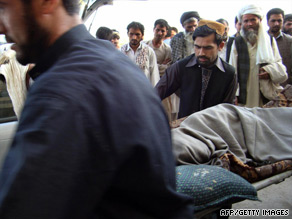
KABUL, Afghanistan (CNN) -- The top U.S. commander in Afghanistan said Saturday he was convinced that civilians, in addition to militants, were among those killed in a NATO airstrike that killed at least 90 people in northern Afghanistan.
Gen. Stanley McChrystal toured the site of the massive explosion that occurred early Friday as Afghans tried to siphon fuel from two tankers that were hijacked late Thursday by the Taliban in Kunduz province.
The fuel was earmarked for NATO's International Security Assistance Force, known as ISAF.
ISAF Capt. Elizabeth Mathias said Friday the military believed there were no civilians near the trucks at the time of the attack. NATO learned afterward that this was not the case. Video Watch more about the airstrikes »
McChrystal visited the hospital Saturday where the injured were being treated.
"It's important to me that we be as honest with the Afghan people and with people around the world as possible," he said.
"Of course, you don't know all the facts until an investigation's complete. And I clearly don't know all the facts now, and would not want to affect a potential investigation by making some conclusion that might be inappropriate.
"But from what I have seen today in going to the hospital, it's clear to me that there were some civilians that were harmed at that site."
The total death toll has varied depending on the source, but local Afghan officials have said at least half of those killed were civilians. Photo See images of the strike aftermath »
NATO and Afghan authorities were investigating.
The Taliban gave villagers the go-ahead to drain the tankers after they became stuck in the mud when the militants tried to drive them through the Kunduz River.
With the trucks stuck on the riverbank, the German commander of the NATO forces in the area called in the airstrike, the German military said. No German soldiers or planes were involved in the attack.
fghan President Hamid Karzai said Friday he was "deeply saddened" by the deaths and reiterated that no civilians should be killed or injured in anti-terrorist military operations.
U.S. Brig. Gen. Eric Tremblay released a statement saying, "ISAF will do whatever is necessary to help the community, including medical assistance and evacuation as requested. ISAF regrets any unnecessary loss of human life
Sep 6, 2009


U.S. general sure Afghan civilians killed in airstrike
KABUL, Afghanistan (CNN) -- The top U.S. commander in Afghanistan said Saturday he was convinced that civilians, in addition to militants, were among those killed in a NATO airstrike that killed at least 90 people in northern Afghanistan.
Gen. Stanley McChrystal toured the site of the massive explosion that occurred early Friday as Afghans tried to siphon fuel from two tankers that were hijacked late Thursday by the Taliban in Kunduz province.
The fuel was earmarked for NATO's International Security Assistance Force, known as ISAF.
ISAF Capt. Elizabeth Mathias said Friday the military believed there were no civilians near the trucks at the time of the attack. NATO learned afterward that this was not the case. Video Watch more about the airstrikes »
McChrystal visited the hospital Saturday where the injured were being treated.
"It's important to me that we be as honest with the Afghan people and with people around the world as possible," he said.
"Of course, you don't know all the facts until an investigation's complete. And I clearly don't know all the facts now, and would not want to affect a potential investigation by making some conclusion that might be inappropriate.
"But from what I have seen today in going to the hospital, it's clear to me that there were some civilians that were harmed at that site."
The total death toll has varied depending on the source, but local Afghan officials have said at least half of those killed were civilians. Photo See images of the strike aftermath »
NATO and Afghan authorities were investigating.
The Taliban gave villagers the go-ahead to drain the tankers after they became stuck in the mud when the militants tried to drive them through the Kunduz River.
With the trucks stuck on the riverbank, the German commander of the NATO forces in the area called in the airstrike, the German military said. No German soldiers or planes were involved in the attack.
fghan President Hamid Karzai said Friday he was "deeply saddened" by the deaths and reiterated that no civilians should be killed or injured in anti-terrorist military operations.
U.S. Brig. Gen. Eric Tremblay released a statement saying, "ISAF will do whatever is necessary to help the community, including medical assistance and evacuation as requested. ISAF regrets any unnecessary loss of human life
Jul 13, 2009
Turkish PM told to take back Xinjiang genocide remark

Straits Times
BEIJING (Reuters) - An official Chinese newspaper urged Turkish Prime Minister Tayyip Erdogan on Tuesday to take back remarks that genocide was being committed in China's Muslim region of Xinjiang, where rioting left at least 184 dead.
In Xinjiang's worst ethnic violence in decades, Uighurs attacked Han Chinese, the country's predominant ethnic group, in regional capital Urumqi on July 5 after police tried to break up a protest against fatal attacks on Uighur workers at a factory in south China.
Han Chinese launched revenge attacks two days later.
In an editorial headlined "Don't twist facts," the English-language China Daily said the fact that 137 of the 184 victims were Han Chinese "speaks volumes for the nature of the event."
The death toll included 46 Uighurs, a Turkic people who are largely Muslim and share linguistic and cultural bonds with Central Asia.
The newspaper urged Erdogan to "take back his remarks ... which constitute interference in China's internal affairs."
More than 1,600 people were wounded and more than 1,000 detained in an ensuing crackdown.
In comments broadcast live on NTV television last Friday, Erdogan told reporters: "The incidents in China are, simply put, a genocide. There's no point in interpreting this otherwise."
He called Chinese authorities to intervene to prevent more deaths.
Turkish nationalists see Xinjiang as the easternmost frontier of Turkic ethnicity. Thousands of Uighurs live in Turkey.
Turkey has sought to boost ties with China, the world's third-biggest economy. President Abdullah Gul last month became the first Turkish president to visit China in 15 years, signing $1.5 billion worth of trade deals, according to Turkish media.
Gul also visited Xinjiang during his trip.
HOTBED
Xinjiang has long been a tightly controlled hotbed of ethnic tensions, fostered by an economic gap between Uighurs and Han, government controls on religion and culture and an influx of Han migrants. Uighurs make up almost half of Xinjiang's 20 million people, but are a minority in regional capital Urumqi.
Beijing does not want to lose its grip on Xinjiang, a vast desert territory that borders Russia, Mongolia, Kazakhstan, Kyrgyzstan, Tajikistan, Afghanistan, Pakistan and India, has abundant oil reserves and is China's largest natural gas-producing region.
On Thursday, Erdogan said Turkey would grant a visa to exiled Uighur leader Rebiya Kadeer, who is based in the United States. Kadeer told Turkish television that Turkish authorities had twice denied her visa application to visit the country.
Jul 6, 2009
In India's Financial Hub, Mumbai, 'Sea Bridge' Aims to Ease Congestion

umbai "Sea Bridge" is inaugurated with fireworks
By Anjana Pasricha
New Delhi
In India's financial hub Mumbai, a bridge has been built over the sea to ease chronic traffic congestion in one of the worlds' most crowded cities. Updating inadequate infrastructure in Indian cities has become critical as its economy expands.
After a brief inauguration ceremony, ruling Congress Party leader Sonia Gandhi drove on the eight-lane bridge that extends over the Arabian Sea across Mahim Bay.
The 5.6-kilometer bridge is the first to be built over the sea in India, and links the western suburb of Bandra with Worli in south Mumbai. It will cut travel time along this route from nearly 45 minutes to about eight minutes. A one-way trip in a car will cost about $1.
The bridge is expected to ease Mumbai's unending traffic snarls. But it will only make a partial difference in a city where an overburdened transport network makes commuting a nightmare.
Bidisha Ganguly at the Confederation of Indian Industry calls Mumbai's sea bridge a "landmark project" where infrastructure is concerned. "A great beginning has been made with this sea link, and there are opportunities for many more of such projects. Public transport is a major concern, and now with the congestion on the roads, its time to look for alternatives," Ganguly said.
The government says new flyovers, an underground railway, and an expansion of the sea bridge have been planned to cater to the city of 18 million people, and 1.5 million vehicles.
But experts are calling for faster implementation of these projects. In the past, many infrastructure projects have been delayed due to bureaucratic hurdles, lack of funding or litigation over land. For example, the construction of the sea bridge took nearly a decade as protests and litigation from the fishing community held up work until 2004.
The protests were triggered by concerns over the bridge's impact on the sea bed and its implication for the livelihood of fishermen.
It is not just in Mumbai where the transport infrastructure needs to be overhauled. In nearly all Indian cities, roads and mass transit systems have become inadequate as an expanding economy attracts millions of people from rural areas to cities, and the middle class snaps up more cars.
The government acknowledges that infrastructure needs investment of billions of dollars, and has commissioned several projects to build new highways, airports and rail networks. Experts say infrastructure is a key factor in holding back the economy from its full potential.
North Korean Freighter Said to Be Returning to Port

MSN Philippines News
By CHOE SANG-HUN
EOUL, South Korea — South Korea said Monday that a North Korean freighter suspected of carrying banned cargo was expected to return to home port, as U.S. officials claimed that international sanctions had forced the ship to turn back.
The 2,000-ton Kang Nam 1 left North Korea in mid-June, and was believed to be heading for Myanmar only days after the United Nations Security Council adopted a resolution that banned the North from nuclear and ballistic missile tests and called for a global embargo on its trade in weapons.
The American Navy tracked the ship amid suspicions that the North was using the voyage to test Washington’s will to enforce the sanctions. Late last month, the ship turned around and began sailing homeward. On Sunday, Vice President Joseph Biden said the ship turned back because the U.N. sanctions prevented it from entering any port.
The ship was sailing in international waters between China and the Korean Peninsula on Monday and was likely to enter North Korean waters within the day, Won Tae-jae, a spokesman of the South Korean Defense Ministry, said Monday.
North Korea has not explained why the ship appeared to have canceled its voyage.
American authorities monitored the ship on the high seas but did not stop and search it — _ a move the North said it would interpret as an act of war _ while working with regional governments to inspect the ship under the U.N. mandate if it entered their ports.
The South Korean authorities suspect the Kang Nam 1 was carrying a cargo of rifles and rocket launchers for Myanmar, the South Korean Yonhap news agency reported on Monday, quoting an unnamed government source. If the ship indeed was carrying weapons, aborting its voyage would be seen as a victory for the sanctions regime.
The Security Council imposed the sanctions after the North tested a nuclear weapon on May 25.
In a gesture of defiance, meanwhile, North Korea fired seven ballistic missiles Saturday during the July 4 Independence Day holiday in the United States.
South Korea’s mass-circulation Chosun Ilbo newspaper reported Monday that the missiles fired on Saturday included three Scud-ER missiles, which have a range of up to 620 miles and can hit Japan.
The Defense Ministry here said it could not confirm the report. But South Korean officials have told reporters that the North appeared to have fired five Scuds and two Rodong missiles.
Five of them plunged into the same zone in the sea between the North and Japan, indicating that the North was improving its firing accuracy, they said.
“Some of it seems like almost attention-seeking behavior,” Mr. Biden told the American television network ABC on Sunday, referring to the North’s latest missile tests. “ I don’t want to give the attention.”
The North Korean cargo ship turned around because the United States has “succeeded in uniting the most important and critical countries to North Korea on a common path of further isolating North Korea,” Mr. Biden said. “There was no place they could go with certitude that they would not be, in fact, at that point boarded and searched.”
Philip S. Goldberg, the American diplomat coordinating enforcement of the U.N. sanctions, visited Malaysia on Monday for talks with officials there. Unconfirmed press reports in South Korean said that Washington has found bank accounts in Malaysia used by North Korea for its illicit trading and sought to shut them down. Malaysian Foreign Minister Anifah Aman could not confirm the reports but pledged that his government will work with the United States.
“If they have evidence, we’ll be most willing to work together to solve this problem,” he said, according to The Associated Press.
Mr. Goldberg was in Beijing last week to discuss sanctions enforcement with officials in China, the North’s largest trade partner and aid provider.


